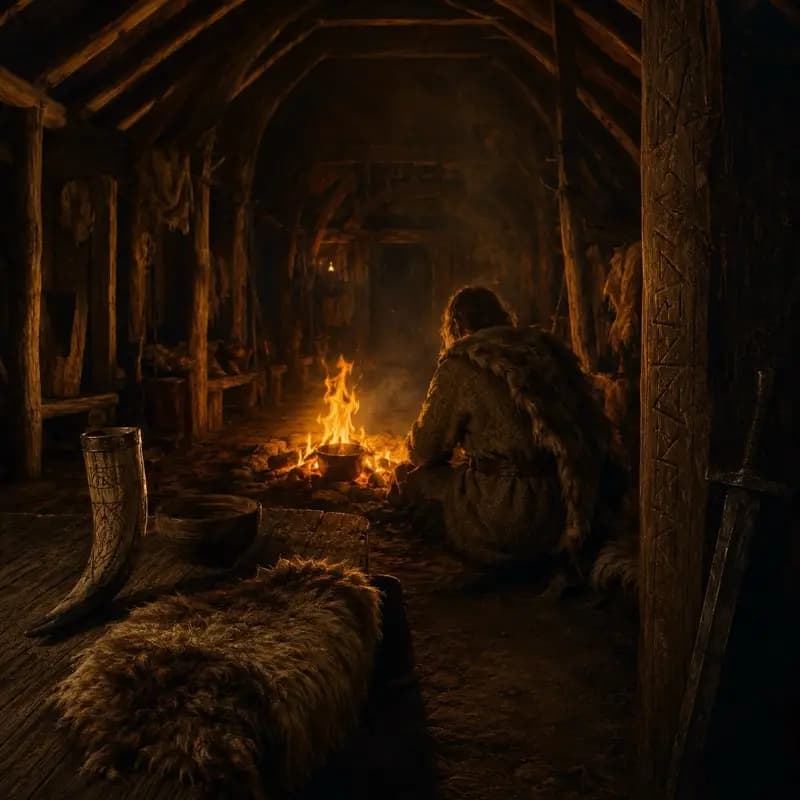
Morning on an Icelandic farmstead. The mist over the lava field will not lift before noon. In the longhouse, where people and part of the livestock live together, a woman blows the embers in the central hearth back to life; smoke rises through an opening in the roof. Outside is the fjord, with a ship at anchor; the snow on the mountains will not go even in summer.
This is the age when Northern Europe is in motion. From Norway, Denmark, and Sweden the ships come out — long, narrow, with carved prows, able to cross the open ocean and to enter shallow rivers. Some sail west: to the Shetlands, to the Orkneys, to Ireland, to the coasts of England. Some go east: up the rivers of the Slavic lands, to Constantinople, as far as Baghdad. And some go north and west, into the unknown: to the Faroes, then to Iceland, then to Greenland, then to a shore they will call Vinland and that we know as North America.
Norwegians, fleeing the consolidation of royal power, settle Iceland — an island with no native people but a few Irish monks who leave quickly. Here they build a society without a king. Once a year, all free men gather at Þingvellir — a natural amphitheater of stone — to hear the law and to judge cases. This is the oldest functioning parliament in the world, and it still meets today.
Life is hard. The land yields poorly. Sheep and cattle give wool, milk, and meat. The forests are gone almost as soon as the settlers arrive; ships are built from driftwood or from timber brought back from Norway. The winters are long. The dark season is the time for telling. Stories first pass around the hearth, and two or three centuries later someone will begin to write them down, and they will become the sagas — one of the strongest literary traditions of the medieval world.
A man's word is worth more than his sword. Reputation is everything. An insult is remembered for decades. Revenge is a duty. But the law works too: a killing can be settled with a payment, a quarrel can be brought to the Thing, and the Thing's ruling is final. Life is short, and that is what makes it dense.
This era holds lives in many forms — settlers on the western coasts of Iceland, traders moving between Norway and the British Isles, skalds in the service of kings, women who run great farmsteads and whose word in the household decides much, lawspeakers and judges of the Thing, wandering smiths and silversmiths, and those who go further west — beyond Greenland, to coasts no one has yet seen.