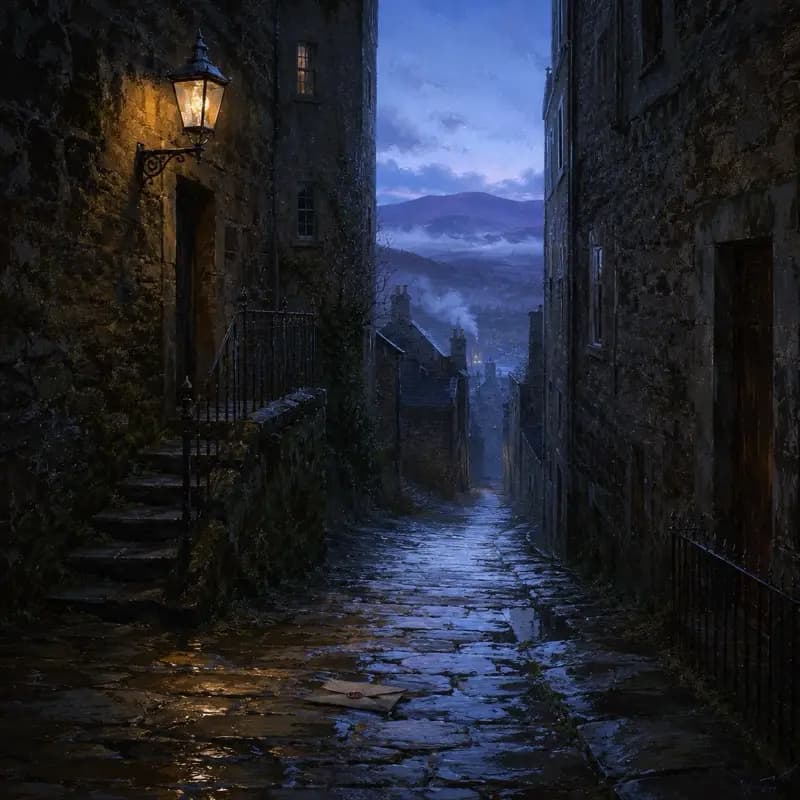
The fog over Princes Street lifts by midday, and out of it appears the Old Town — its six-storey tenements, its stepped wynds, its church spires, its apothecaries, its printing houses. Three hundred miles to the north, another world: highland glens where the old men still remember how a clan made decisions at the fire, and where, on a road, Gaelic is heard more often than English.
This is the era in which Scotland lives between two worlds, and that fault line shapes everything. Since 1707, Scotland has been in union with England, and formally the country no longer exists; but Scottish law, the Scottish Kirk, the Scottish universities remain. The Jacobite rising of 1745 has been crushed, and after it the clans of the highlands have been forcibly disarmed, Gaelic banned in schools, the tartan outlawed for a time. The harshness will soften, but the wound stays.
And at the same time, in Edinburgh, an intellectual fire is burning. David Hume writes on human nature. Adam Smith lectures on moral sentiments and on the wealth of nations. The Medical School becomes the best in Europe. In a single tavern in the Old Town — Anchor Close, or perhaps the Isle of Man — you can find a philosopher, a physician, a poet, an engineer, and a half-drunk advocate arguing over the same table. The printing presses run day and night; books written here reach London, Paris, Philadelphia.
Life depends on where it is lived. In Edinburgh it is dense, urban, learned. A tenement on the High Street divides itself between a dozen families of every station — a lord on the top floor, a shopkeeper on the third, a chairman in the cellar. They greet each other on the stairs. Gas lighting has not yet come; evenings are candles and coal fires. Water is carried from public wells. The smell of fish from Leith mingles with the smell of smoke.
In the highlands, life is slower and poorer. Sheep are beginning to replace the old patterns. Letters from London take a week; newspapers arrive a week older. In winter the wind is such that windows have to be sealed with wax. On Sunday the minister preaches for two and a half hours, and no one leaves.
This era holds lives in many forms — young men reading medicine or law at the university, daughters of Presbyterian ministers in country manses, merchants and printers of the Old Town, heirs of highland families moving to Edinburgh or London, midwives and apothecaries, and those who live on the seam between two worlds and write their letters in two languages.