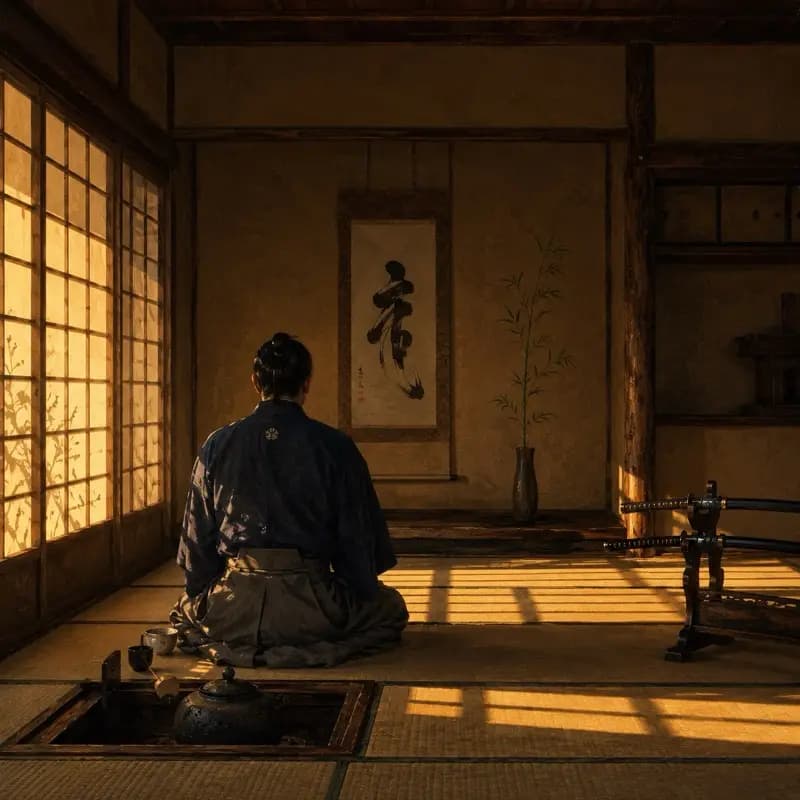
Late evening in the Yoshiwara district of Edo. Paper lanterns along the canal, the thin sound of a shamisen from a second-floor window, the smells of rice cooked with eel and of pinewood burning in the braziers. A samurai in plain dark robes crosses the bridge; his two swords are at his belt, but in this city he has used them, for years, only to wipe the dust away.
This is Japan in its long peace — the Edo period, two and a half centuries without major war. The Tokugawa shogunate, having taken power in 1603, reordered the country so that conflict between great houses became impossible. The samurai remain a class — about seven percent of the population — but they have no one to fight. They become administrators, scholars, sword-teachers without students, debtors to merchants, inheritors of a long memory no one else seems to need.
The merchants, by contrast, are growing rich. Edo grows to a million inhabitants and becomes the largest city in the world. Osaka is the financial capital; Kyoto, the cultural and spiritual one. The three are connected by the great highway, the Tōkaidō, on which thousands of travelers move every day — porters, couriers, pilgrims, women on new contracts, troupes of actors on their next tour.
The country is closed. Foreigners are permitted only at Nagasaki, and only the Dutch and the Chinese. Japanese are forbidden to leave on pain of death. News of the outside world arrives in a thin trickle: Dutch books translated by a handful of scholars, sailors' rumors, whispers of distant lands. Inside the country, it does not reach far — and inside the country, an inner life flourishes.
Kabuki and Nō. The tea ceremony. The woodblock prints called ukiyo-e — pictures of the floating world, of courtesans and actors. The haiku, brought to perfection by Bashō, then by Buson, then by Issa. Schools of swordsmanship in which masters pass on traditions to students who will never draw a blade in earnest. Small moments are made into art, because the great events are scarce.
This era holds lives in many forms — samurai of lower rank in administrative posts, daughters of merchant houses in Osaka, actors of the Kabuki theater, craftsmen who carve woodblocks or forge swords, geisha in the early days of that tradition, wandering poets and pilgrims, monks of Zen temples, and those who live along the Tōkaidō and watch the whole country pass by.