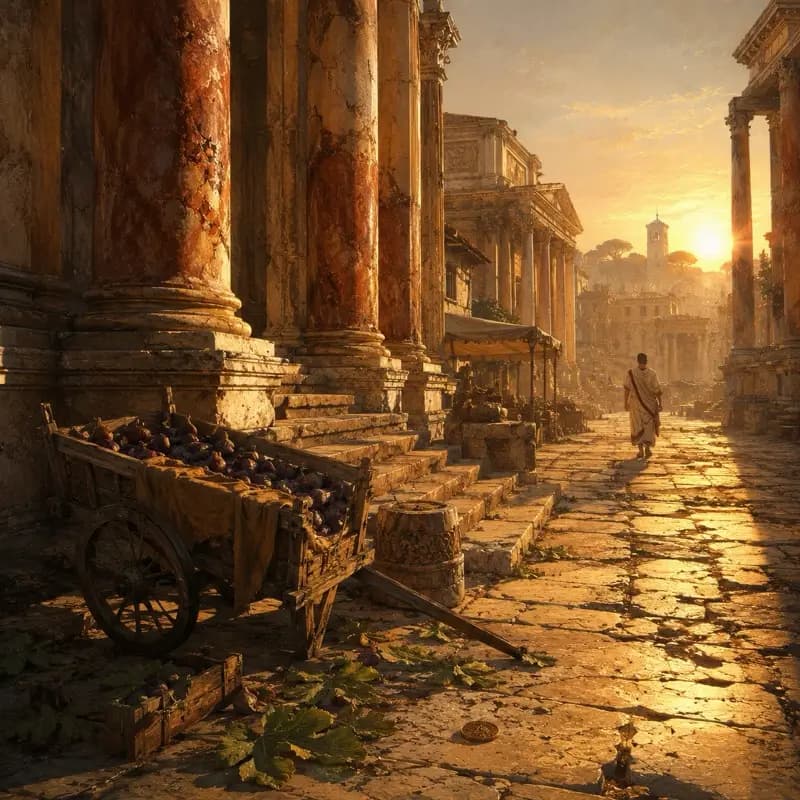
Midday in the Subura — the densest and poorest of the city's quarters. From the upper floor of an insula someone is shouting the morning's news, on the lower floor the looms are clattering, in front of the door a woman is selling hot flatbread and warmed wine. Across a narrow street between buildings, a clothesline reaches to a fifth-floor window; below it passes a woman in a stola, and behind her a senator's litter borne by four men.
This is the Rome of Augustus and his heirs — Tiberius, then Claudius and Nero, then Vespasian and his sons. The Republic is dead, but in public speech it is still spoken of as though it breathed. The emperor rules, but is called princeps — first among equals. The Senate meets and passes the decrees expected of it. Everyone knows how power works, and everyone behaves as though it works otherwise.
The city is a million strong. This is staggering for the ancient world. Carts move through the streets every night, because wheeled traffic in the center is forbidden by day. From the aqueducts pours water that has traveled tens of miles through stone channels, into fountains, into the great public baths. Bread is given out free to several hundred thousand citizens. At the games in the Colosseum, newly built, the crowd debates not the gladiators but the emperor in his box.
Life depends on which floor of the insula you live on. On the ground floor — shops, noise, the danger of fire that comes once a year. On the upper floors — rooms without water, without heat, and the rent rises anyway. In wealthy houses — frescoed walls, mosaic floors, an inner courtyard with a fountain, a marble table at which one reclines to eat. Everyone has slaves; one man has one, another has a thousand. Freedmen are the most mobile people of the age; their grandsons may rise to the equestrian order.
Religion is everywhere and nowhere. Gods stand at every crossroad and on every household altar. They are addressed by name and for a purpose. From the provinces come new cults — of Isis, of Mithras, of Cybele. On the eastern edge of the empire, in Judea, something is happening that history will record later, and no Roman of these years has yet noticed.
This era holds lives in many forms — young craftsmen from the provinces seeking their fortune in the capital, freedmen and their families newly placed in the city, military tribunes at the beginning of their careers, women of equestrian families, traders in eastern silk and spice, actors and musicians, and those who live on the frontier of the empire and are not certain whether they count as Romans.