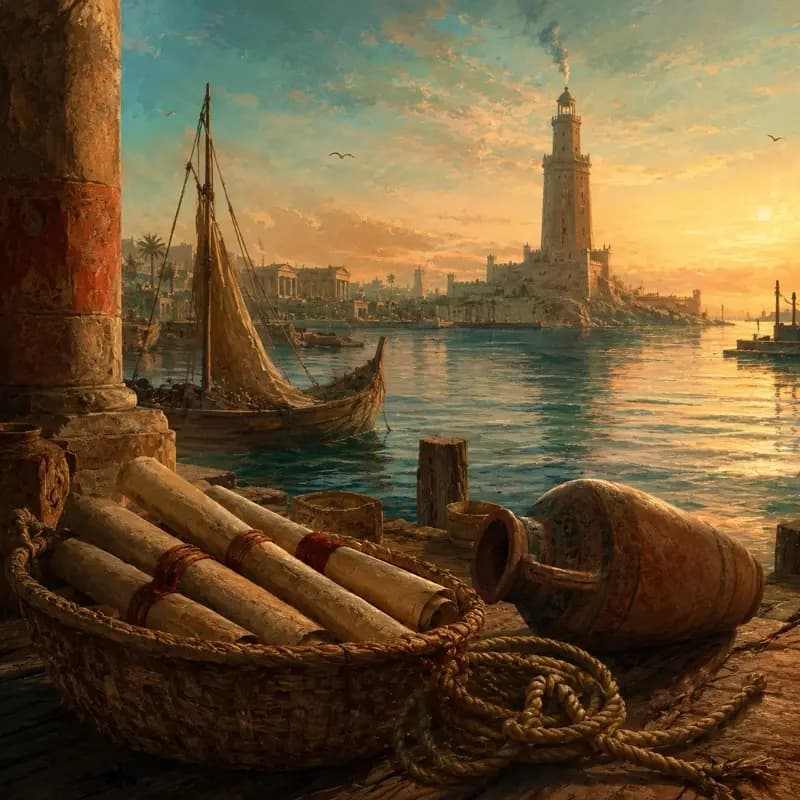
First light over the harbor. The Lighthouse — the Pharos, one of the wonders of the world — is still burning at the top of its tower, a column of stone and bronze taller than any other structure on the Mediterranean. Ships from every known shore are anchored in the two basins of the harbor: grain ships from the Egyptian interior, merchant vessels from Rhodes, traders from Massalia, an Indian ship that came up through the Red Sea with peppercorns and ginger.
This is the city that Alexander left behind. He founded it in 331 BCE on the western edge of the Nile Delta; he never saw it built. His general Ptolemy took Egypt as his share of the conquered world, and Ptolemy and his descendants — Ptolemy II, Ptolemy III, and so on through more than two centuries — turned the city into the capital of the Hellenistic world.
The Library of Alexandria has been gathering scrolls for two hundred years. Every ship docking in the harbor is searched, and any books found are taken to the Library, copied, and the copies returned to the owners; the originals stay. The collection holds, by some reports, half a million scrolls. The Museum, attached to it, supports scholars on royal salary — mathematicians, astronomers, geographers, physicians, philologists. Euclid wrote his Elements here. Eratosthenes measured the circumference of the earth here. Aristarchus argued that the earth moves around the sun, and was not believed.
The city is Greek-speaking, but its people are not all Greek. Egyptians live in the older quarter to the south. Jews — a community of perhaps a hundred thousand, the largest outside Judea — live in their own quarter on the east and translate their scriptures into Greek, producing the Septuagint. Cyreneans, Syrians, Persians, traders from Arabia and India all live here. All conduct their business in koine, the common Greek of the eastern Mediterranean, the language in which a generation later the New Testament will be written.
Life is urban in a way that few cities of the ancient world have managed. Wide streets laid out on a grid. A causeway connecting the mainland to the island where the Lighthouse stands. Public gardens. Theaters. A royal quarter with palaces and the tomb of Alexander himself, displayed in a glass case. Down at the harbor, longshoremen and customs officials and merchants negotiate in three languages, and everyone takes a cut.
This era holds lives in many forms — young scholars at the Museum, copyists and binders in the Library, merchants in the Emporion handling the trade between east and west, midwives and physicians of mixed Greek-Egyptian practice, daughters of Jewish families of the Delta quarter, priests of the older Egyptian temples now reshaping themselves under Greek rule, sailors of the harbor, and those who live in the city without belonging fully to any of its languages.