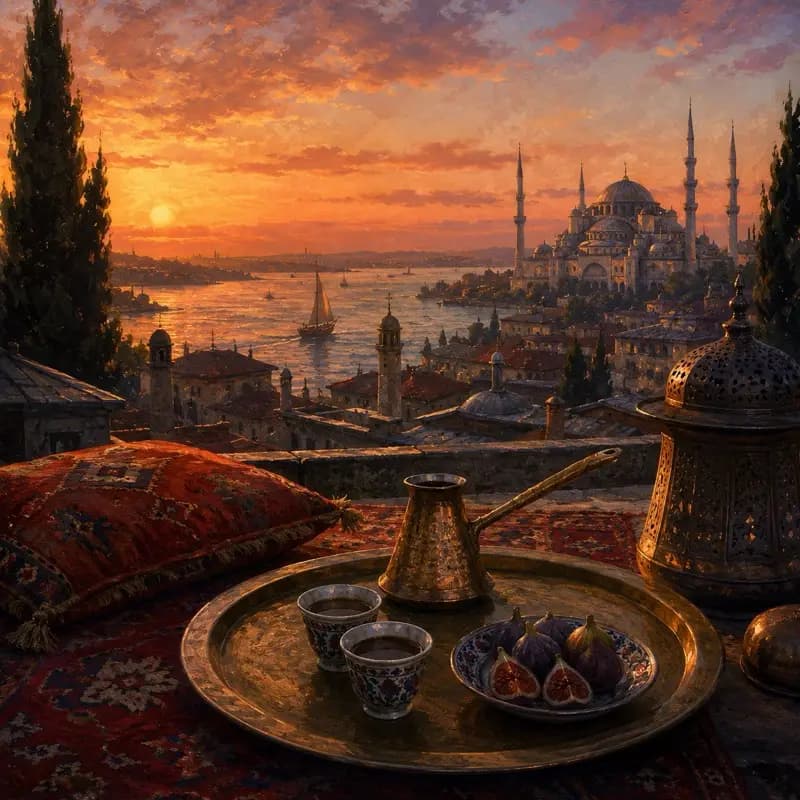
Early morning on the Bosphorus. On the European shore the muezzin of the Hagia Sophia calls the first prayer; from the Asian shore the muezzin of a small mosque in Üsküdar answers. A caïque — a long, narrow boat with a single oarsman — moves across the water, carrying a woman in her ferace to visit relatives. On the quay below, barefoot porters unload sacks of grain from Egypt.
This is the capital of the Ottoman Empire in its maturity. A city on two continents, the capital of three: the Sultan's domains stretch from Algiers to Baghdad, from Budapest to Cairo. Istanbul is the largest city in Europe, with a population of more than half a million. People here speak Turkish, Greek, Arabic, Armenian, Ladino, Italian, the Slavic tongues. Almost no one is local in a single generation; everyone comes from somewhere.
The imperial system is built on the principle of autonomous communities — the millets. The Orthodox Greeks have their own patriarch; the Armenians, theirs; the Jews, their rabbi; the Muslims, their sheikhs and judges. Each community runs its own schools, its own courts, its own taxes. All pay the Sultan and answer to the imperial law, but otherwise live parallel lives, lives that touch each other at the bazaar.
And the bazaar is the center. The Grand Bazaar spans several streets under a single roof, with thousands of shops: spices, fabrics, carpets, gold, coffee, weapons, ceramics from Iznik, silks from Bursa. The coffeehouses — a relatively recent thing, brought from Yemen in the previous century — have become the center of urban life. There people play chess, read aloud, argue, tell stories. The meddah poets earn their bread by recounting the tales of Köroğlu and the love of Leyla and Majnun.
Caravans come in from Aleppo with silk and spice; ships of Venetians, Ragusans, and Dutchmen unload in the Golden Horn. Every other person in this city is a spy. A foreign ambassador keeps a staff of dragomans; the Sultan's council reads dispatches from Venice the morning after they are written. Information is merchandise. A word is merchandise. A skill is merchandise.
This era holds lives in many forms — young merchants of Greek or Armenian families in the quarter of Phanar or in Galata, craftsmen in the weavers' and jewelers' districts, women in households of the civil administration, dragoman-translators in the foreign embassies, poets and calligraphers in the entourage of a vizier, dervishes of the Sufi orders, pilgrims and traders arriving in the city, and those who live in Üsküdar on the Asian shore and see the city as a far silhouette across the water.