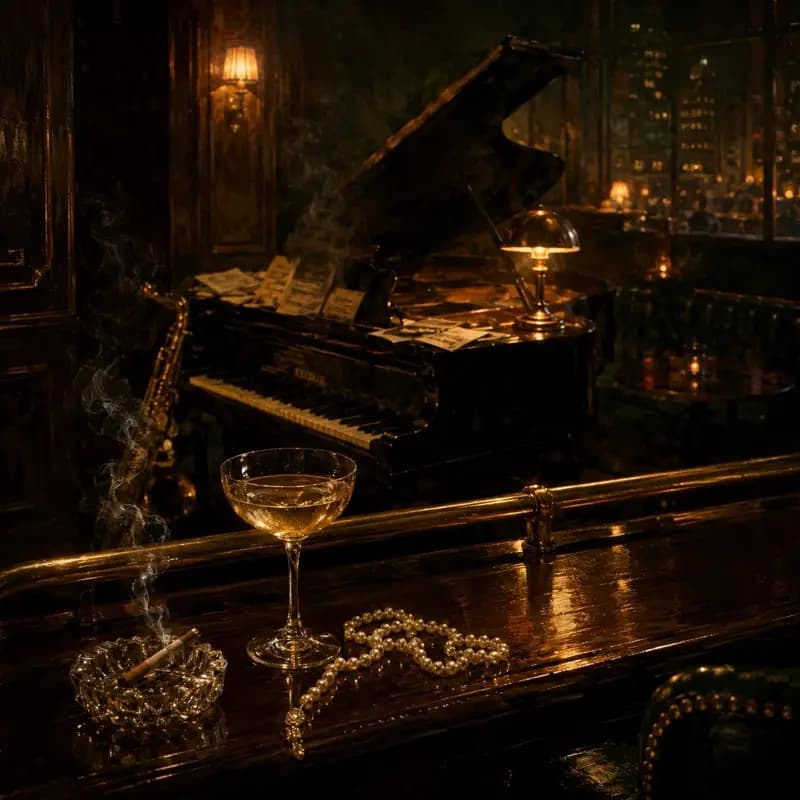
Midnight on 52nd Street. From the basement door of a place marked simply "Tony's" a couple steps out into the cold, he in a tuxedo, she in a beaded dress; behind them lingers the smell of gin, of smoke, of the orchestra inside playing "Sweet Georgia Brown." Across the street a young man in a fedora climbs out of a taxi and slips into his pocket the card that will admit him, on Wednesday, to another club on another street — none of which has a sign at the door.
This is a city that has just realized it is the capital of the century. The Great War ended five years ago, and Europe is recovering more slowly than expected. Wall Street is climbing, climbing. The skyline rises before your eyes: in 1913 the Woolworth Building was the tallest in the world; within ten years it will be passed by the Chrysler, and then within a year by the Empire State. Buildings go up so quickly that pedestrians stop to watch them.
The Eighteenth Amendment, since 1920, has prohibited the manufacture and sale of alcohol. In response, the country drinks more than ever. New York fills with speakeasies — basement clubs reached through a door behind a laundry, a tailor's shop, a flower stand. The orchestras play loud. The dancers learn the Charleston, the Black Bottom, the lindy. Women cut their hair, raise their hems, and shock their mothers; they call themselves flappers. The cocktail is invented as a way of making rough bathtub gin palatable; the cocktail party follows.
In Harlem the jazz is being made — by musicians who came up from New Orleans, from Chicago, from rural Mississippi. The Cotton Club has white audiences and Black performers. The Apollo, just below, has both. Langston Hughes is writing; Zora Neale Hurston is writing; the Harlem Renaissance is a name that will be used later, but the thing itself is already happening. Down on the Lower East Side, Jewish immigrants from Russia and Poland are raising their children in cramped tenements; one of those children will become George Gershwin.
Money is everywhere and unreal. The stock market is rising on a kind of faith. A stenographer can buy stocks on margin and a year later quit her job. Everyone has a story about someone who became rich. Nobody yet has a story about what happens after.
This era holds lives in many forms — young writers fresh from the Midwest, immigrants from Russia or Poland working in the garment trade, musicians from New Orleans newly arrived in Harlem, women starting careers as journalists or commercial artists, sons and daughters of old money meeting sons and daughters of new, bartenders in speakeasies and the patrons who knew them by name, and those who live in the outer boroughs and ride the new subway into a Manhattan that does not quite belong to them.