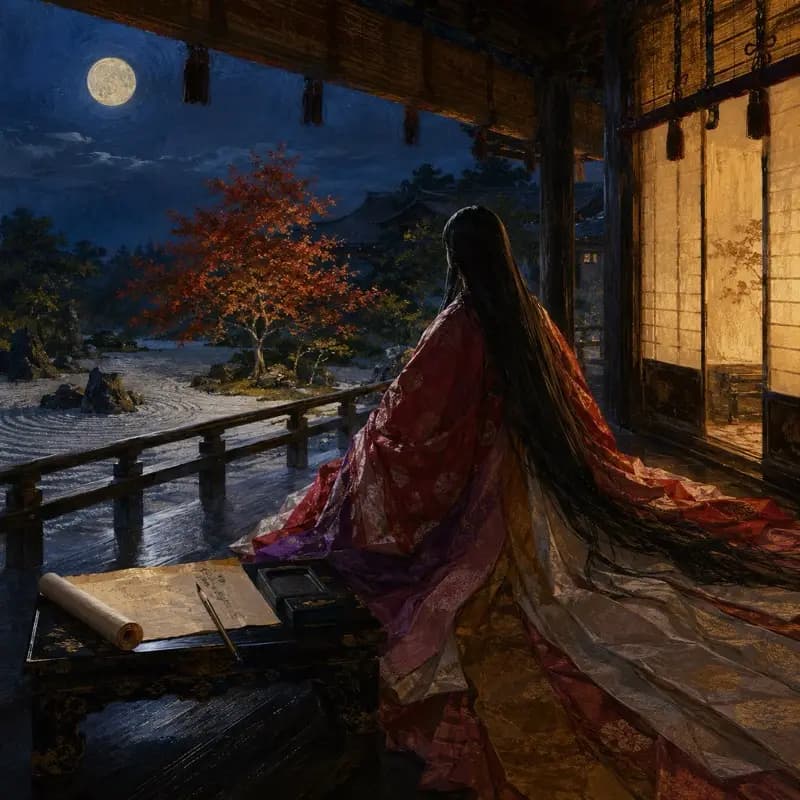
Morning in the capital begins with the rustle of sleeves and the sound of doors that should not be heard sliding open. A court lady rises before her women have finished arranging the screens, and already her day is shaped by what cannot be left undone: a letter that should be written before the dew lifts, a poem owed in return, a color of paper that must match the weather.
This is the era when the Japanese court decided that inner life mattered more than outer. The imperial capital — Heian-kyō, which we now call Kyoto — became for two centuries the center of a world in which refinement weighed more than power. Soldiers were almost invisible. Officials wore robes of such complexity that the layers became a language. Women wrote — wrote more, and wrote more seriously, than men, and wrote in their own Japanese, while the men labored to sound Chinese.
Life here followed the calendar of seasonal rituals and observations. The plum blossom in the first month. The moon in the eighth. The angle of light across a screen at noon. Small things carried the weight of larger ones, because the larger things — war, famine, upheaval — were kept beyond the walls of the great compounds by curtains and silence. What in other times was background became, here, the stage: what gift arrived at dawn, in what color the reply came back, how a fan was folded, what was noticed in another's verse.
Days passed between pavilions, verandas, and carriages. The houses of the great families were not houses as we know them but linked halls under a common roof, divided by screens and curtains through which every sound traveled. Privacy in the modern sense did not exist. But hearing did — hearing of footsteps, of breath, of the tone in which someone spoke your name. Love began with a voice behind a screen, continued through letters, and ended when the handwriting changed.
Beyond the capital, the provinces ran on their own time. A posting to a distant district was a punishment even when the appointment was honorable. Monks in the mountain temples lived nearer to the earth and the weather. The warriors of the eastern marches were beginning to grow into a force the court did not yet notice, and would not notice until far too late.
This era holds lives in many forms — ladies-in-waiting at the court, provincial officials and their daughters, monks and nuns in mountain temples, poets in service and poets in disgrace, daughters of great houses whose fates turn on a correspondence, and those who live at a distance from the capital and see it as a far light against the sky.