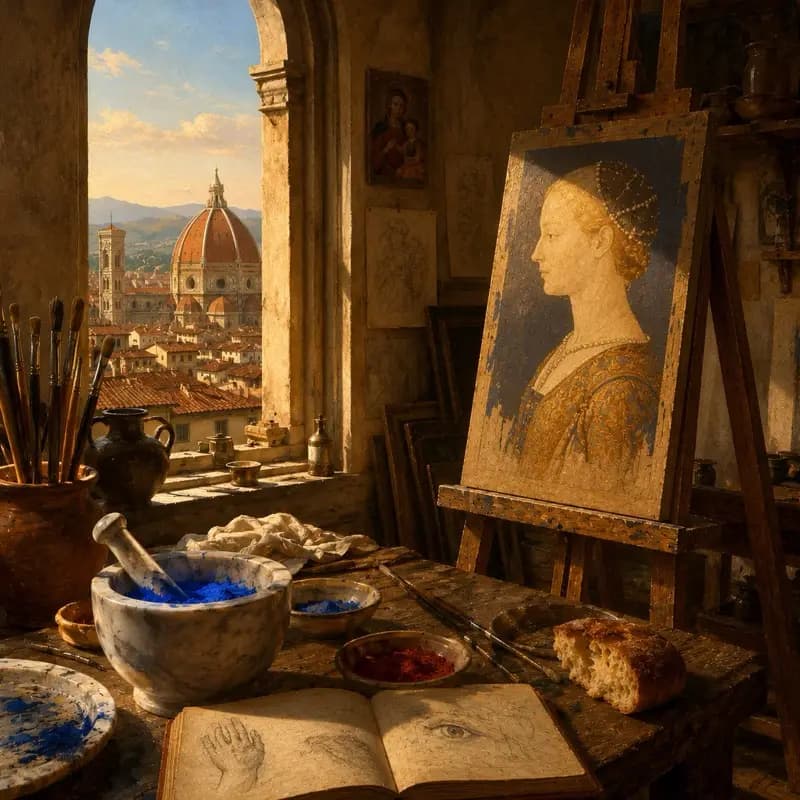
A workshop in late afternoon, on a narrow street in the quarter of San Lorenzo. The apprentice grinds pigments in a mortar — lapis lazuli, malachite, lead white — while the master, on a scaffold across the room, paints the underdrawing of a fresco. A messenger comes in from the Medici palace with a query about whether the price they agreed on includes the cost of the gold leaf. The master, without looking down, says it does not.
This is Florence in the fifteenth century, in the years when the city is reinventing what a city can be. The Medici, who began as bankers, have come to dominate without quite ruling: they hold no formal title, but the Signoria does nothing of consequence without their approval. Cosimo built the family's wealth and laid the political foundation; his grandson Lorenzo — Lorenzo the Magnificent — will use the wealth to buy paintings, manuscripts, statues, and the loyalty of poets. The city has perhaps sixty thousand inhabitants. Almost everyone knows someone who knows the Medici.
The workshops are the engine of it. A painter takes commissions for altarpieces, frescoes, portraits, marriage chests; a sculptor for monuments and tomb effigies; a goldsmith for cups, reliquaries, and the small ornaments of an aristocratic life. Apprentices begin at twelve or thirteen, sleeping in the workshop, learning to grind colors before they touch a brush. The most ambitious become masters; the rest stay assistants their whole lives. Behind every painting whose name you know stand five or six people whose names you don't.
The banks lend to kings — to the kings of France, of England, of Naples — and the loans secure influence even more reliably than they yield interest. Wool comes in from England as raw fleece and goes out as dyed cloth worth ten times what was paid for it. The Arno is a working river, lined with mills and dyeing-yards. The Cathedral, with its great dome that Brunelleschi finished in 1436, dominates every view; it is the largest dome built in Europe since antiquity, and people still come from other cities just to look up at it.
The Church is everywhere. There are conspiracies inside cathedrals — the Pazzi conspiracy of 1478 will see a Medici murdered during High Mass. There are sermons on the public squares in which a preacher denounces vanity, jewelry, painting, books, and gathers a following. In a few decades a Dominican friar named Savonarola will burn objects of art in the Piazza della Signoria, and a few decades after that he will be burned there himself.
This era holds lives in many forms — apprentices in the painters' workshops, daughters of merchant families brought up to manage estates, notaries handling the papers of every transaction in the city, monks and nuns of the urban houses, woolworkers from the cloth guilds, mercenaries returning from a campaign in the south, foreign students at the new universities, and those who live in the contado, the countryside around the city, and bring their oil and wine to its markets.