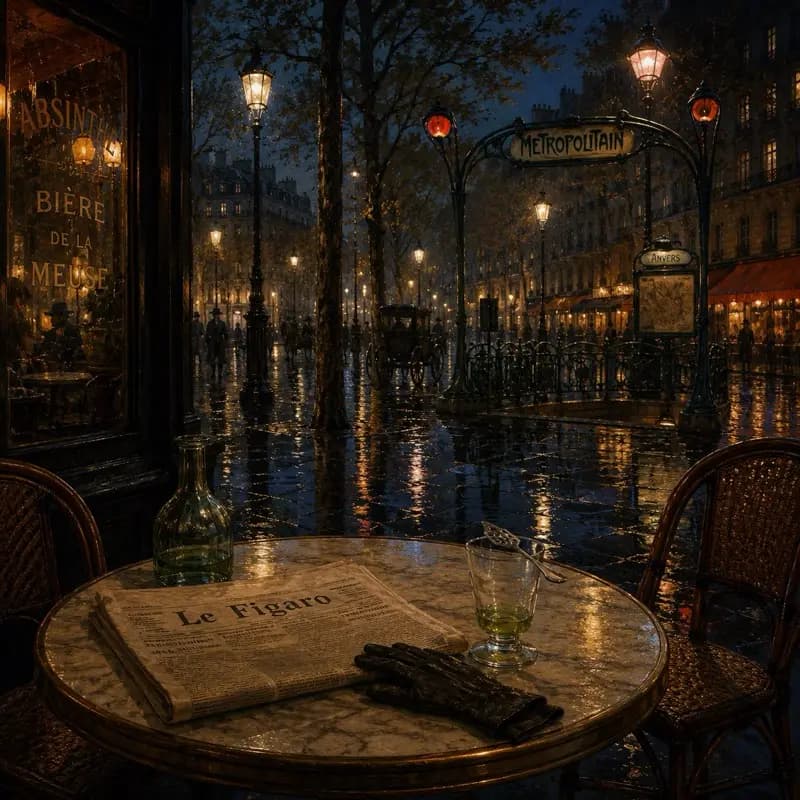
A Sunday afternoon in the Luxembourg Gardens. Children push toy sailboats around the octagonal basin, old men sit on the benches with their newspapers, couples walk the gravel paths — he in a top hat, she with a parasol. Somewhere off to one side, a medical student is reading Bergson; on the bench across, an elderly woman in black lace remembers the Commune.
This is the era that will be called Belle Époque only afterward — after the First World War, when it becomes obvious that something has ended. For now it is simply Paris: the capital of the world, the center of art, of fashion, of science, of medicine, of engineering. The Eiffel Tower has stood since 1889 and is slowly ceasing to seem absurd. In 1900 the World's Fair brings fifty million visitors to the city. That same year the first line of the Métro opens.
Technology changes everything. Electric lights are replacing gas lamps, and will replace them entirely. The automobile appears and slowly displaces the horse-drawn omnibus, though for a long time they share the boulevards. The cinema is born in the basement of the Grand Café in 1895. Radio is not yet here but is close. The telephone enters the houses of the rich. The city itself is being rebuilt under Haussmann's plan — broad boulevards, uniform façades — and this new geometry becomes what the world now calls "Parisian."
Art is in ferment. The Impressionists, who twenty years ago were a scandal, are now selling. The Post-Impressionists, the Cubists, the Fauves — every decade brings a new direction, and each is hissed at before it is bought. On the slopes of Montmartre the painters are hungry; in a few years some of them will be in museums. In the literary salons they read Mallarmé, then Verlaine, then Rimbaud. In the theaters they stage Chekhov and Maeterlinck. Sarah Bernhardt plays Hamlet — in the role of Hamlet.
And across this background, the Dreyfus affair, which divides the country in two. A captain of Jewish origin is accused of espionage on false grounds; some demand a retrial, others defend the honor of the army. Families break apart. Friends stop speaking. Émile Zola writes J'accuse, and he is convicted of libel. By the time the affair ends, the country looks different than it did at its beginning.
This era holds lives in many forms — young painters and models on Montmartre, medical students at the Sorbonne, daughters of bourgeois families coming out into society, women journalists in the years when the profession first opens to them, civil servants and lawyers caught up in the Dreyfus years, musicians and actresses, immigrants from Poland, Russia, Italy arriving in Paris for the freedom of it, and those who live in the outer arrondissements and see the city as a distant light.